 The Amber Archive
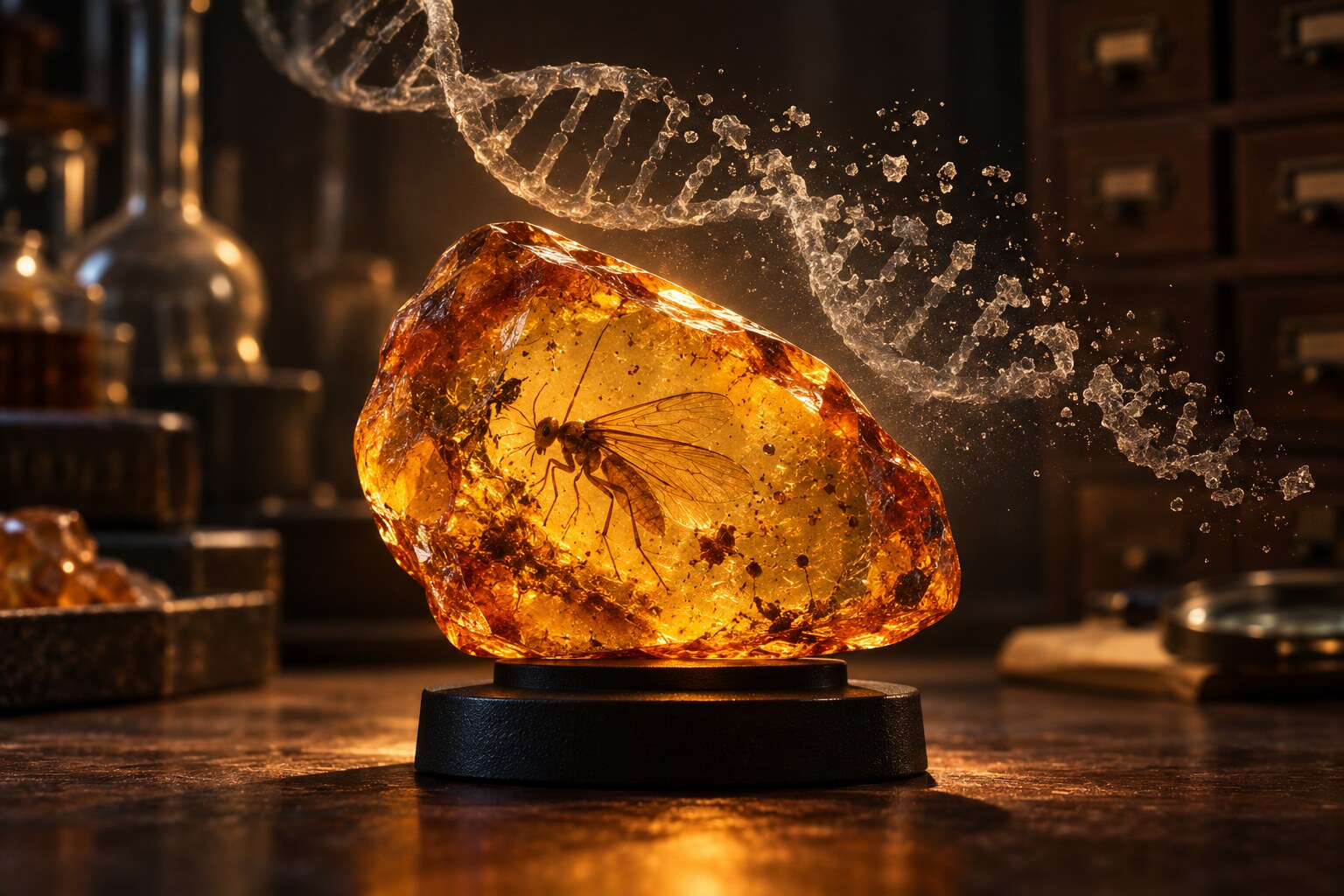
DNA in amber has not been shown to survive for millions of years in a reproducible, authenticated form. Amber can preserve the shape of an insect with extraordinary detail, but lifelike anatomy is not the same thing as intact genetic material. Researchers have recovered DNA from much younger remains in other environments, yet the famous idea of reading dinosaur DNA from an amber-trapped insect remains science fiction.
That answer is less dramatic than a movie, but the scientific story is genuinely interesting. It shows why an exciting result must survive contamination controls, independent testing, and repeated experiments before it becomes reliable evidence.
Why the idea seemed plausible
Fresh resin can engulf a small organism quickly. As it hardens, the resin may isolate delicate wings, hairs, and other structures from scavengers and physical disturbance. Early researchers reasonably wondered whether that protective enclosure might also preserve molecules inside the animal's cells.
In the early 1990s, several teams reported DNA sequences from insects in amber, including Dominican amber tens of millions of years old and much older Cretaceous material. These claims arrived just as PCR—the polymerase chain reaction—made it possible to amplify tiny amounts of DNA. The combination was irresistible: exceptional fossils, a powerful new laboratory method, and the cultural shadow of Jurassic Park.
The difficulty is that PCR also amplifies small amounts of modern contamination. DNA from people, microbes, laboratory materials, or living relatives of the target insect can overwhelm a weak ancient signal. A convincing result therefore needs strict controls and independent reproduction, not simply a sequence that appears biologically plausible.
Repeated tests did not confirm the early claims
In 1997, Jeremy Austin and colleagues tried to reproduce reported DNA recovery from amber- and copal-preserved bees and flies. They did not detect authentic ancient insect DNA. Their paper concluded that the lack of reproducibility argued against DNA surviving over geological timescales in amber.
A 2013 study applied next-generation sequencing to two stingless bees in Colombian copal, a younger resin material discussed in our amber vs. copal guide. One inclusion was less than about 60 years old; the other was dated to roughly 10,600 years. The researchers found no convincing endogenous bee DNA in either specimen. Because copal is far younger than most amber, the negative result deepened doubts about million-year-old claims.
These studies do not prove that every molecule disappears on an identical timetable. They show that the claimed ancient sequences have not met the tests required to establish their authenticity.
Newer experiments keep the question narrow
A 2020 study recovered DNA from beetles embedded in two- and six-year-old resin collected in Madagascar. That result matters, but it is not ancient DNA and it does not bridge the enormous gap to fossil amber. The authors presented their work as a careful starting point for testing progressively older samples, with contamination controls and modern sequencing methods.
The same paper explains why the problem is difficult. DNA begins breaking down after death through enzyme activity and chemical reactions. Heat, pressure, water, and the later geological history of resin can further reduce the chance of preservation. A clear insect outline can persist after its original molecules have been altered or lost.
This is a useful example of the distinction in our article on why amber identifications can change: observation and interpretation should stay connected, but they are not interchangeable. Seeing an insect is evidence of preserved form, not automatically of preserved genes.
What a DNA claim would need to show
A credible deep-time DNA result would require clean-room procedures, negative controls, characteristic damage patterns, a sequence that fits the proposed organism, and independent replication. Researchers would also need to rule out modern contamination and explain exactly how the specimen was collected, stored, prepared, and dated.
One surprising sequence would not be enough. The methods and raw evidence would need to let other laboratories test the same conclusion. That is why the published debate focuses so heavily on reproducibility. Scientific caution here is not a refusal to discover something new; it is how a new discovery earns confidence.
What this means for collectors
An insect inclusion should not be advertised as containing recoverable ancient DNA unless rigorous published evidence exists for that individual specimen. A mosquito-like insect does not establish that it fed on a dinosaur, retained blood, or preserved a usable genome. Carnegie Museum of Natural History notes that non-avian dinosaur DNA has never been successfully extracted from amber or any other fossil.
Do not cut, crack, dissolve, or drill amber in search of genetic material. DNA analysis is destructive, contamination-sensitive work for specialist laboratories, and a small inclusion may be scientifically or aesthetically valuable without yielding molecules. Begin with non-destructive documentation: preserve the provenance, retain the seller's original claims, and use our guide to photographing amber inclusions to record the piece from several angles.
Amber remains an exceptional window into ancient anatomy and ecology. Its value does not depend on hiding a genetic code. The most accurate label today is also the most useful one: amber can preserve remarkable fossils, but authentic million-year-old DNA from those inclusions has not been demonstrated reproducibly.