 The Amber Archive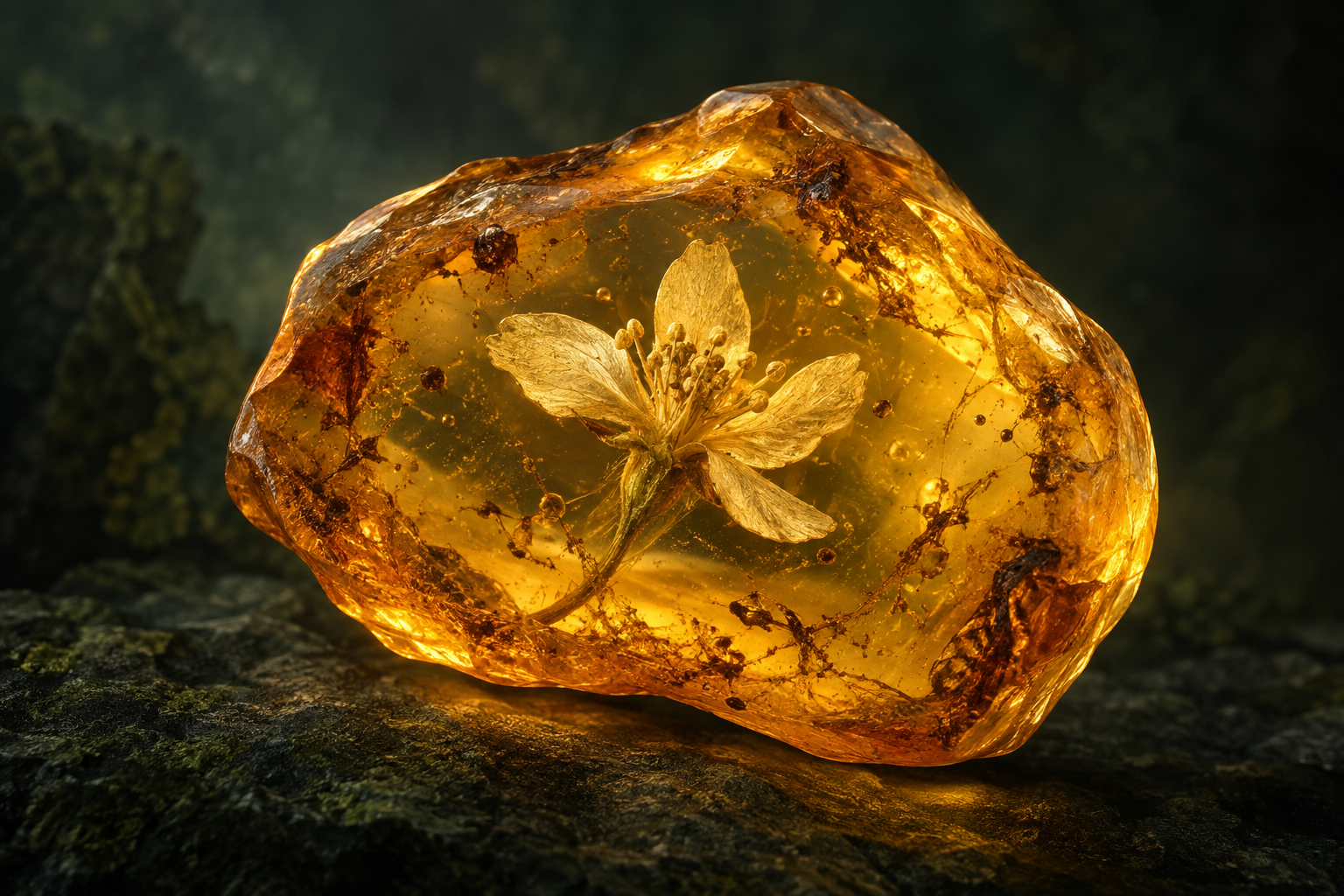
An amber inclusion can look wonderfully familiar. A petal, a wing, a tiny leg: your eye finds a pattern, and a name comes to mind. But recognizing a shape and identifying a fossil are different jobs. One especially memorable flower offers a good reason to leave room for a second look.
This is a story about research published in 2023, not a newly announced discovery. Its lesson is still useful: a specimen can stay exactly where it is while our understanding of it changes.
The flower that changed families
In a study published on January 12, 2023, Eva-Maria Sadowski and Christa-Charlotte Hofmann revisited a flower preserved in Baltic amber. Measuring 28 millimeters across, it was described in their paper as the largest known amber-preserved flower. The fossil comes from late Eocene Baltic amber.
It had originally been named Stewartia kowalewskii, placing it in the tea family. The researchers examined the flower's structure and pollen extracted from its anthers, the pollen-bearing parts. That combination supported a different placement: Symplocos kowalewskii, in the sweetleaf family.
The reassignment also made it the first reported record of that family in Baltic amber. The authors connected its botanical affinities with evidence for ancient forests resembling certain modern East and Southeast Asian forests.
Importantly, they also called for more comprehensive pollen comparisons to clarify its relationships within the family. A stronger identification did not mean every question was settled.
A changed name is not a failed specimen
For a collector, a revised label might initially feel disappointing. If a name changed, was the earlier story worthless? A more useful response is to ask what new evidence became available and how it affected the interpretation.
Think of a label as an explanation attached to an object, not as part of the object itself. You can appreciate the specimen while remaining willing to update the explanation. There is no contradiction in saying, “This is fascinating, and I would like to understand the identification better.”
That approach also helps when reading research headlines. “Reidentified” does not automatically mean a fossil was recently excavated, newly purchased, or found in a different country. Before passing along a story, check what actually changed: the specimen, the analysis, the name, or the proposed relationship.
Read the evidence, not just the headline
Try a simple three-question reading habit the next time an amber discovery catches your attention.
First, what did the researchers examine? Look for the actual specimen and the features discussed. Resist jumping straight from an attractive photograph to the most exciting possible interpretation.
Second, how did they make the comparison? You do not need to master every technical term. Start by looking for a connection between a visible feature, a method, and a conclusion. When that connection is unclear, treat it as a question to explore rather than a gap to fill with a guess.
Third, where does their confidence stop? Words such as “likely,” “supports,” and “suggests” deserve to survive the journey from research paper to social post. Replacing them with “proves” can turn an interesting result into a claim the researchers never made.
For this flower, keep “largest known” tied to the 2023 paper. A research record is not a promise that no larger example can ever be found.
Curiosity does not require cutting
Reading about laboratory work can make hands-on experimentation sound tempting. For a personal collection, however, the sensible first move is a question, not a blade. Do not cut, scrape, heat, or dissolve a specimen to imitate a research method.
GIA describes amber as soft, with poor toughness, and notes that chemicals and heat can damage it. Those properties are good reasons to keep casual investigation non-destructive.
If an inclusion seems scientifically unusual, contact a relevant museum or specialist with clear photographs and the documentation you already have. Ask whether further assessment is worthwhile before considering any alteration. A request for advice does not establish an identification, and an exciting resemblance does not authenticate a specimen.
Keep the wonder, leave room for revision
The most rewarding takeaway is not that every collector needs a more impressive label. It is that a good question can be more valuable than a quick answer.
Enjoy what you can see. Be precise about what you cannot yet explain. And when better evidence changes the story, let that be another reason to look closer.