 The Amber Archive
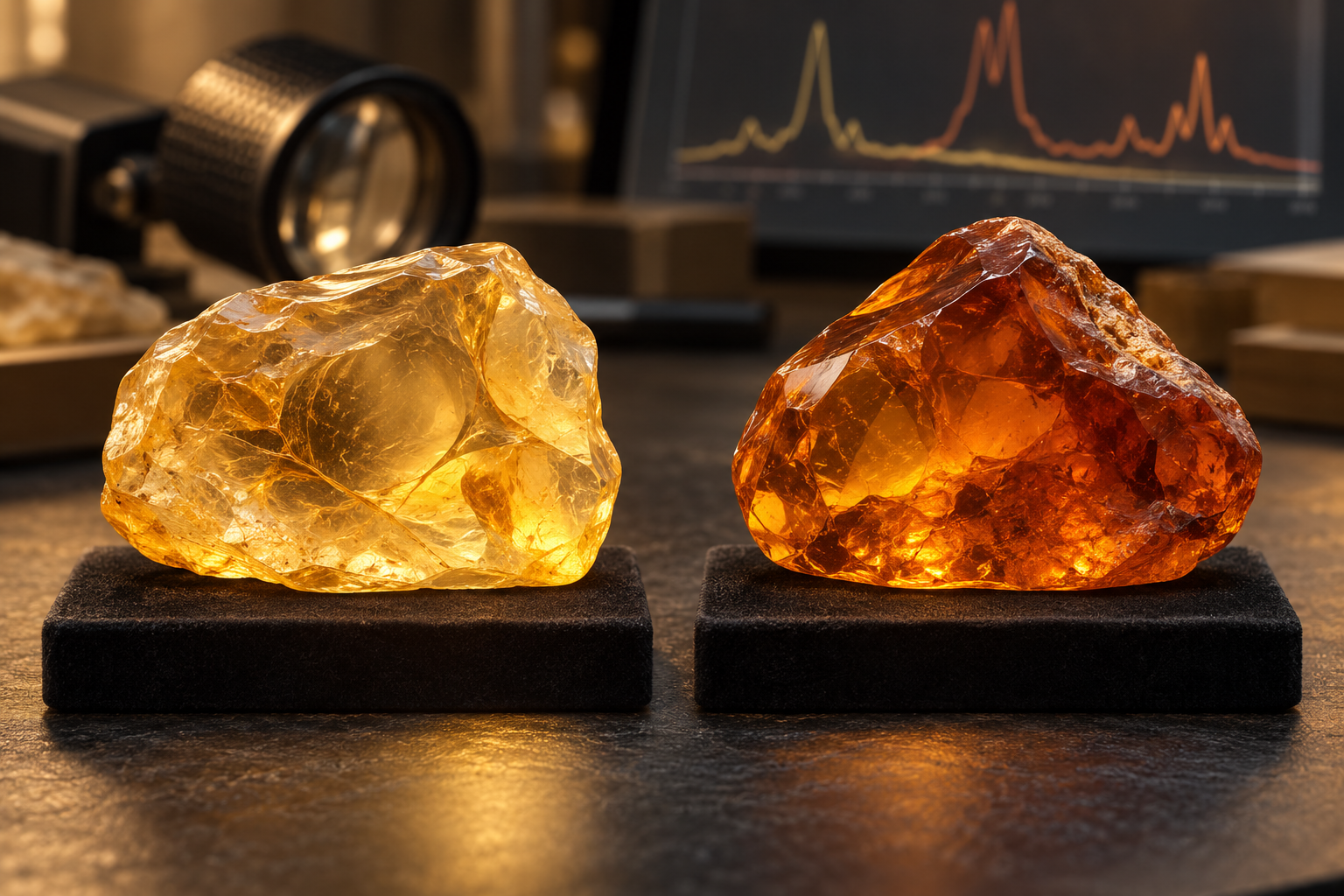
Amber and copal both begin as tree resin, but they represent different stages in a long and complicated transformation. Amber is generally treated as the more mature, fully fossilized material. Copal is less mature resin, often younger and less completely polymerized. The useful answer, though, is not simply that amber is old and copal is young: scientists and gemologists do not all use one universal age boundary.
That nuance matters when you are reading a listing. A seller should identify the material as accurately as the evidence allows, not upgrade copal to amber because both can look golden, transparent, and wonderfully convincing.
The same beginning, a different history
A tree releases resin as a sticky defense material. After burial, that resin can lose volatile components and undergo chemical changes, including polymerization and cross-linking. The result is a continuum rather than an instant jump from fresh resin to copal and then, on a particular birthday, to amber.
GIA gives collectors a practical rule: its amber description calls copal a younger related resin, generally less than one million years old, and amber older than one million years. That is a clear gemological convention. In scientific literature, however, the terminology is still debated because age and chemical maturity do not always line up neatly across deposits and botanical sources.
Why there is no universally accepted cutoff
A 2020 Scientific Reports paper described the early stages of resin fossilization and the word “copal” as subjects of continuing debate. Its authors proposed a new age-based definition: copal from the Pleistocene and Holocene, between 2.58 million years ago and 1760. That proposal is useful for certain paleontological questions, but it is a proposal—not a rule adopted by every laboratory, museum, or seller.
Another 2020 study, focused on so-called Madagascar copal, noted that published age cutoffs have ranged widely. The authors emphasized that resin-to-amber change is chemically complex and that a simple date does not capture every stage of maturation. For collectors, the honest conclusion is that the label should be tied to the method and convention being used.
Color and clarity do not settle it
Copal can be beautiful. It may be clear, warmly colored, polished, and full of inclusions. Amber can be pale, cloudy, fractured, or dark. There is no reliable visual chart in which one shade means copal and another means amber.
Treatment complicates the picture further. GIA researchers studying commercially treated “green amber” found that heat and pressure could reduce volatile components and make copal behave more like amber in some tests. They described this as artificially aging the material. A polished surface or an amber-like response therefore needs context, especially when treatment history is unknown.
This is one reason our guide to amber authenticity tests treats home observations as clues rather than proof. Appearance can start a question; it should not be asked to finish the identification.
What laboratory evidence can add
Researchers often use Fourier-transform infrared spectroscopy, or FTIR, to examine how a resin absorbs infrared light. The Madagascar study reported differences in particular exocyclic methylene bands between the copal and amber samples it compared. In plain language, the spectrum records chemical features that eyes cannot see.
Even a laboratory result should be read with its scope in mind. Ask what material was tested, which comparison data were used, whether treatment was considered, and what the report actually concludes. Identifying the resin is also separate from proving the age or authenticity of an inclusion inside it.
What to ask before buying
Look for the stated material, locality, dimensions, weight, and photographs of the actual piece. If a seller calls it amber rather than copal, ask what supports that description: deposit information, supplier documentation, a laboratory report, or another method. Save the answer with the listing and receipt. Our first-specimen guide has a simple checklist for keeping that evidence together.
Avoid hot needles, solvents, scratching, or other damaging experiments. If the distinction materially affects the value of a purchase, an appropriate independent laboratory assessment is more useful than a mark left by a home test.
Copal is not failed amber
Calling a specimen copal does not make it uninteresting. The Madagascar research showed why younger resins can preserve valuable records of recent forest ecosystems and living or recently lost biodiversity. Copal can hold its own story; it simply is not the same story as ancient amber.
For a collector, the best label is not the grandest one. It is the one that matches the available evidence and leaves uncertainty visible when the evidence stops.