 The Amber Archive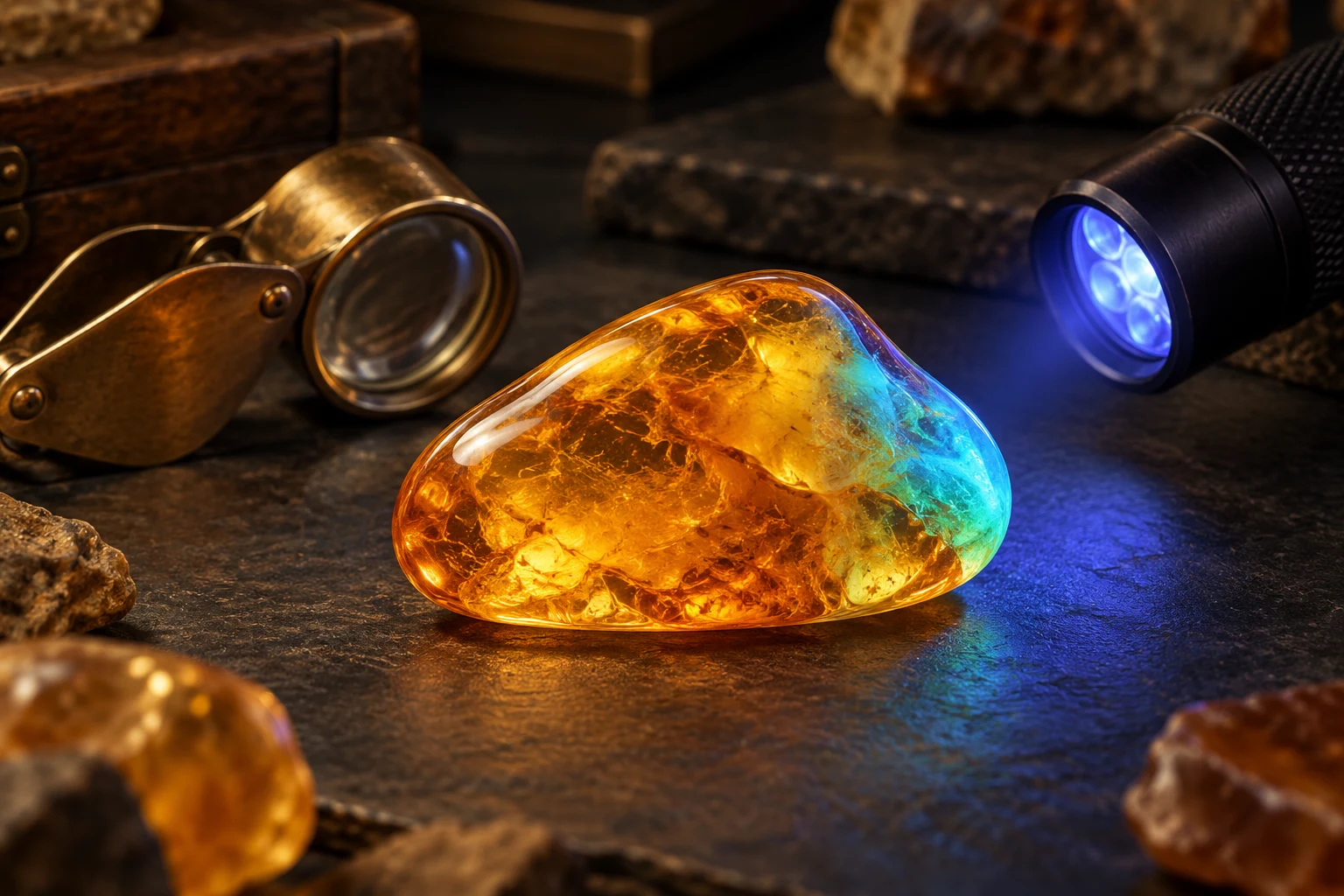
Amber authenticity tests can offer useful clues, but UV light and a saltwater float result cannot, by themselves, prove that a piece is natural amber or that its inclusion is ancient. Treat them as screening observations. When a purchase depends on those claims, ask what additional evidence supports them.
That does not take the fun out of collecting. It gives you a better question than “Did it pass?” Try asking, “What did this test actually establish?” Here is how to read two familiar results without asking them to tell the whole story.
What a saltwater float test tells you
Floating is about density. GIA's Amber Buyer's Guide notes that amber floats in a saturated salt solution, but not in ordinary seawater. The liquid matters, so “floats in water” is already an incomplete description.
More importantly, flotation does not separate every material collectors need to distinguish. In a 2009 Gems & Gemology study of treated “green amber,” researchers found that their amber and copal samples floated in saltwater both before and after heating. The commercial green material they examined floated too. Copal is a less mature natural resin; floating did not resolve that distinction.
The practical takeaway from that study is narrow but useful: a positive float result is compatible with more than one resin material and treatment history. It does not establish an age, a mining locality, or an inclusion's identity. This is an explanation of the test's limits, not a recommendation to immerse a valuable, fractured, repaired, or mounted piece.
What UV fluorescence can show
A glow under ultraviolet light can be fascinating to photograph. It is also an observation that needs interpretation. A particularly clear example appeared in Gems & Gemology in 2013, when researchers described a composite containing natural amber and artificial polymer resin.
Both portions fluoresced. In that particular specimen, the amber appeared blue-white under UV and the artificial resin yellowish green. The researchers used infrared spectra to confirm the two materials. Their findings show why “it glows” is insufficient; those two colors are not a universal identification chart.
If someone supplies UV photographs, ask for matching ordinary-light photographs of the same piece. Record the lamp information if available, and keep the original images. A vivid photograph can help document an observation, but a camera image is not a laboratory conclusion. An unexpected patch is a reason to ask questions, not enough evidence to announce a fake.
The resin and the inclusion are separate questions
That 2013 composite held another useful lesson: it contained one naturally occurring insect inclusion and another insect embedded artificially in the surrounding resin. Finding genuine amber somewhere in an object does not automatically authenticate everything inside it.
When reading a listing, separate three claims: what the surrounding material is, whether an inclusion was enclosed naturally, and what that inclusion has been identified as. Each deserves its own supporting evidence. A broad description such as “insect inclusion” also makes a different promise from a precise species name.
For more on how evidence changes an identification, read our article on why amber identifications can change. For purchase questions beyond testing, our first-specimen guide is a useful companion.
Skip tests that leave a mark
Do not burn, scratch, or apply solvents to a specimen in search of a quick answer. GIA's care guidance describes amber as soft, with poor toughness, and vulnerable to heat and chemicals. A damaged surface is a high price to pay for an uncertain conclusion.
Even if a research paper describes an invasive procedure, that does not make it an appropriate home experiment. Ask a qualified specialist which examination methods suit the object and whether any proposed analysis would alter it. Our amber care guide covers gentle handling and storage while you decide what to do next.
Build an evidence trail before buying
Start a short note with the exact claim you want checked. “Is this natural amber?” and “Is this insect original to the piece?” may require different assessments. Save the listing, whole-piece photographs, dimensions, and any existing report together so the question stays attached to the right object.
GIA recommends an independent laboratory report for a significant purchase when natural amber or an inclusion's authenticity is in doubt. Before commissioning one, confirm the laboratory's scope: ask which of your questions it can answer, what its conclusions would mean, and how the submitted piece will be identified in the report.
Home observations are most useful when they lead to better questions. Enjoy the glow and the tiny details, but let the strength of the evidence set the strength of the claim.