 The Amber Archive
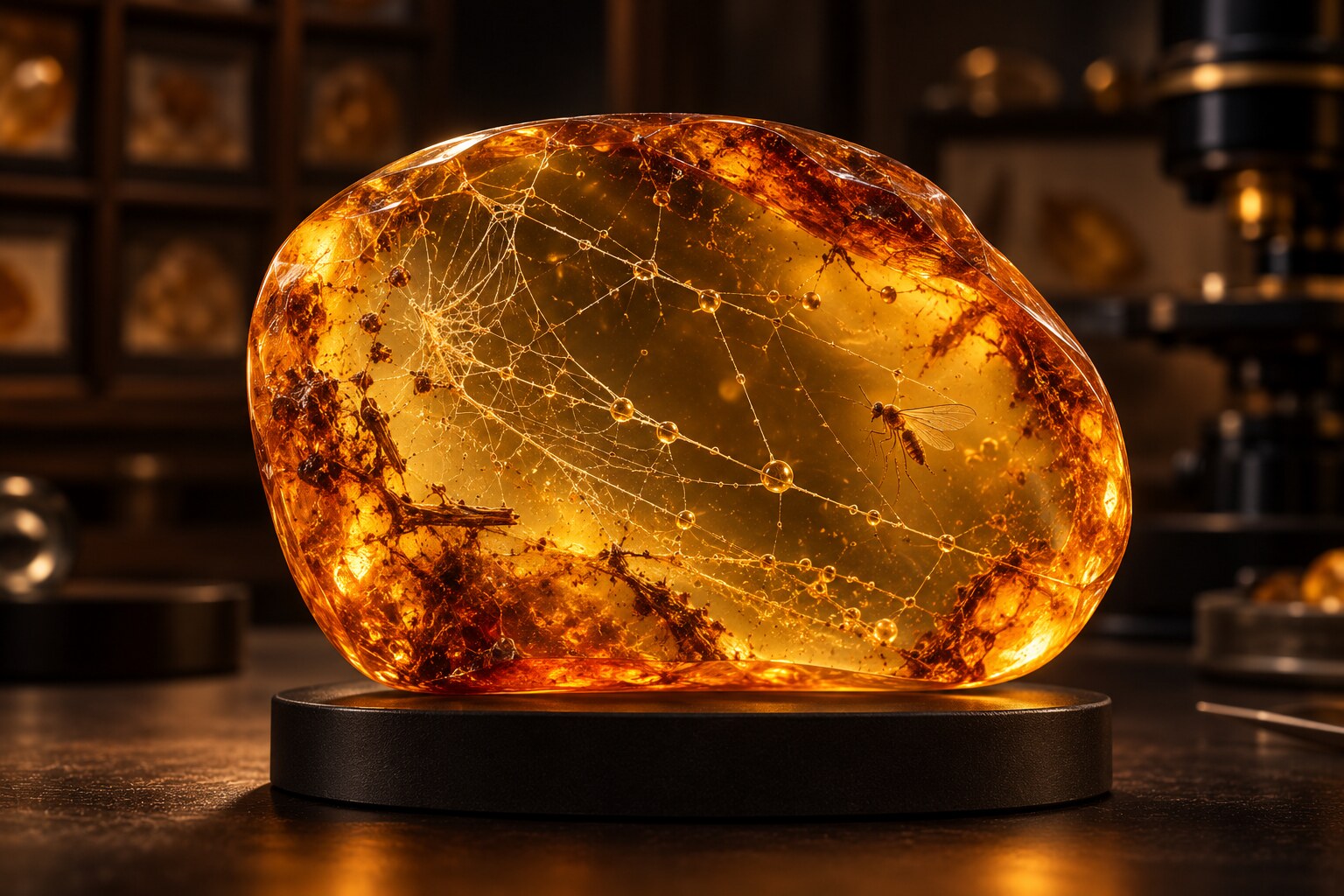
Spider webs in amber are identified from a combination of evidence, not simply from one thread-like shape. Fine strands may be spider silk, but plant fibers, fungal filaments, hairs, cracks, and stretched resin can also look persuasive under magnification. The strongest interpretations connect several clues: consistent threads, junctions, glue droplets, recognizable web geometry, associated prey, and sometimes specialized imaging.
That evidence can reveal more than a spider's presence. A preserved web fragment may record how the animal captured food and how flying insects interacted with predators millions of years ago. The careful question is not just “Does this look like silk?” It is “Which visible features make silk the best explanation?”
One strand is a clue, not a complete web
Spider silk is rarely fossilized, and complete web architecture is rarer still. In 2003, Samuel Zschokke described a single silk thread with glue droplets in approximately 130-million-year-old Lebanese amber. The specimen showed that sticky, or viscid, capture silk existed in the Early Cretaceous. It did not preserve an entire orb web or identify one exact spider species.
That distinction matters for collectors. A long filament crossing an inclusion may deserve attention, but its shape alone does not establish its biological origin. Look for continuity through the resin, a regular diameter, repeated connections, or surface features that differ from nearby fractures. Photograph the whole piece before moving to close-ups so the strand's position remains clear. Our guide to photographing amber inclusions explains how several angles can separate an internal feature from a surface scratch or reflection.
Glue droplets make the interpretation stronger
Sticky capture threads often carry small droplets. Their presence can be an important clue when the droplets repeat along a filament rather than appearing as unrelated bubbles elsewhere in the resin. The 2003 Lebanese specimen was significant because the thread bore preserved glue droplets, a feature tied to prey capture.
Droplets still need context. Resin naturally contains bubbles and flow features, and a photograph can flatten separate structures into an apparent connection. Researchers compare size, spacing, attachment to the strand, and surrounding anatomy rather than treating every bead-like shape as web glue.
This is the same evidence habit discussed in our article on why amber identifications can change: a label should become more specific only when the specimen supplies more specific evidence.
Connected strands and prey can preserve behavior
A 2006 Science paper described a much richer web fragment in roughly 110-million-year-old amber from Spain. The American Museum of Natural History reports that the piece preserved 26 silk strands, many connected to one another, along with glue droplets and several trapped arthropods, including a fly, mite, beetle, and wasp.
The strand directions, junctions, short perpendicular connections, loops, and associated prey supported the interpretation of a gummy aerial web. Some features resembled part of an orb-weaver's sticky spiral, although the researchers also considered a comb-footed spider. The evidence was strong for an araneoid capture web; it was not strong enough to name the exact maker with certainty.
That is an unusually important difference. A prey item touching a stray filament is suggestive. Multiple prey connected to a structured network of sticky strands preserve a much fuller ecological event.
Imaging can reveal geometry hidden in resin
Amber bends light, surface irregularities distort fine details, and several strands may overlap in a single photograph. Researchers therefore use more than ordinary viewing when a specimen warrants it. A 2014 study of Late Cretaceous French amber combined conventional and confocal microscopy to describe web architecture in three dimensions. The networks appeared more irregular than a classic two-dimensional orb and were compared with cob-type or sheet webs.
The researchers also reported preserved autofluorescence associated with spider silk proteins and proposed additional characters for recognizing fossil web fragments. That does not turn fluorescence into a universal home test. Instrument settings, preparation, comparison material, and expert interpretation all matter. Advanced imaging strengthens a documented analysis; it does not let a single glowing line identify itself.
What collectors should record—and avoid
If a piece appears to contain spider silk, save the original listing and any locality or age documentation. Record dimensions, make photographs of both faces, and capture the suspected strands from more than one angle. Describe what is visible before assigning a web type or spider family. “Possible connected silk strands with bead-like droplets” is often more useful than a dramatic name unsupported by the evidence.
Do not cut, heat, dissolve, drill, or aggressively repolish the amber to expose a filament. GIA describes amber as soft, vulnerable to chemicals and heat, and best cleaned gently with warm water and a soft cloth. Follow our amber care guide while seeking an opinion from a museum or qualified specialist if the structure seems unusual.
Spider webs in amber are compelling because they can preserve both material and behavior. Careful wording does not make the story smaller. It shows which details are directly visible, which interpretation they support, and which questions the specimen still leaves open.