 The Amber Archive
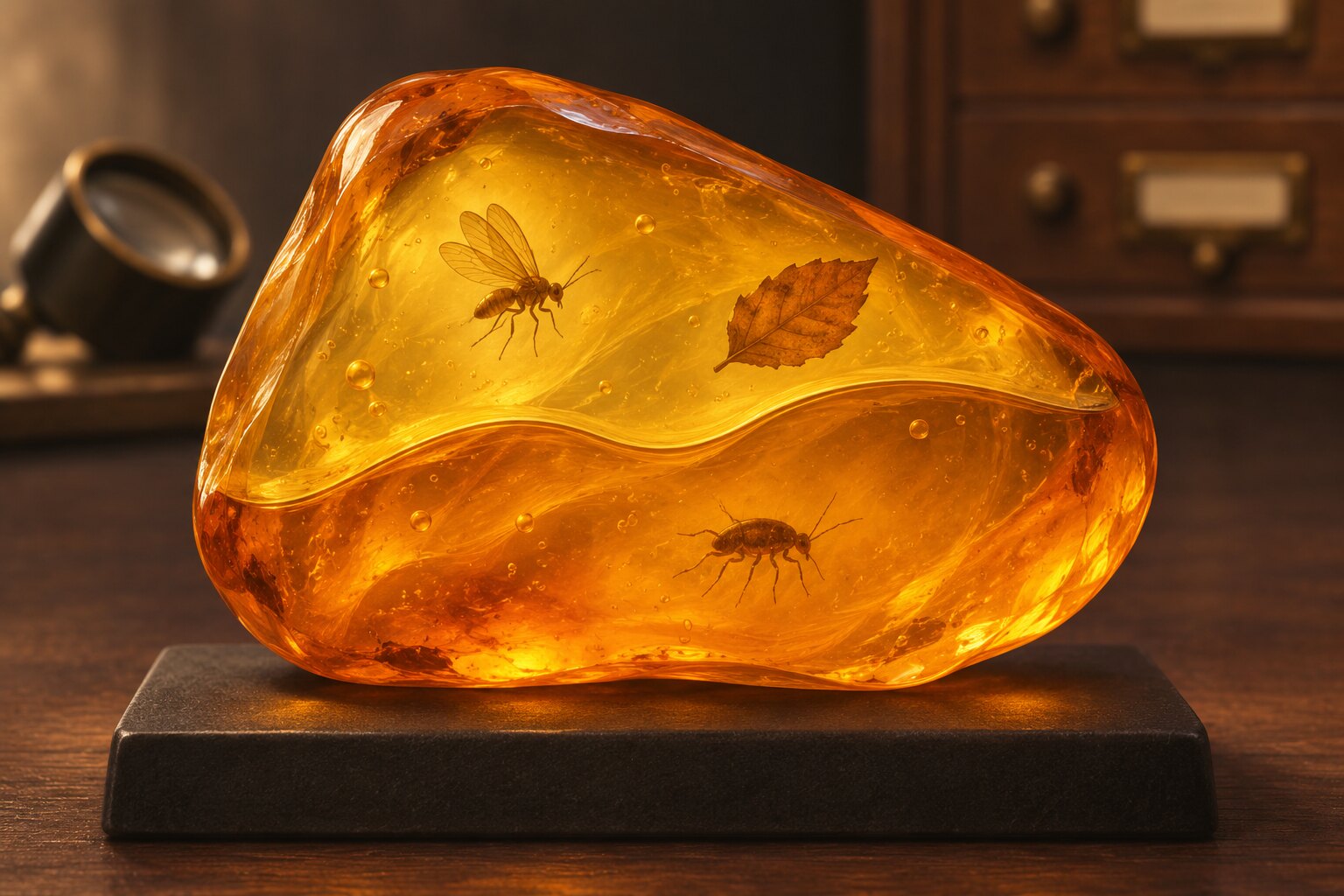
Multiple inclusions in amber can preserve one short-lived scene, but sharing one polished piece does not automatically mean every organism arrived together—or interacted. Researchers first ask whether the inclusions occupy the same original resin layer. They then examine position, physical contact, preservation, and the processes that could have brought each organism into the resin.
The broad term for biological remains preserved together in one amber piece is syninclusions. That can include animals, plants, fungi, or fragments of them. Bubbles and non-biological particles are not syninclusions. The word is useful, but it is only the beginning of the interpretation.
One piece can contain more than one resin flow
Fresh resin may spread in repeated pulses. A later flow can cover an earlier one, eventually hardening into what looks like a single piece. In a 2023 Scientific Reports study, researchers formalized a helpful distinction: eusyninclusions occur in the same resin layer, while parasyninclusions occur in different layers of the same amber piece. Each layer can represent a separate microevent.
That distinction changes the story. Two insects separated by a flow boundary may have lived in the same local environment, yet entered the resin at different moments. Cutting and polishing can also remove part of the outer shape, making separate layers harder to follow. A flat photograph may visually stack inclusions that are actually at different depths.
The same layer supports coexistence, not automatic interaction
Eusyninclusions provide stronger evidence that organisms were close in space and time. Even then, proximity alone does not prove predation, mating, parasitism, or cooperation. One animal may have entered after another was already immobilized; both may simply have encountered the same sticky surface.
A 2026 study of Baltic amber ants shows how scientists move beyond a dramatic single piece. The researchers examined 3,246 ant specimens, identified 110 multi-species eusyninclusions, and analyzed patterns of co-occurrence. Their community-level interpretation came from a large dataset and statistical comparison—not from assuming that two nearby ants were visibly competing. The authors expressly note that co-occurrence does not necessarily record direct interaction.
Behavior needs a stronger chain of evidence
A behavioral interpretation becomes more persuasive when anatomy and position fit a specific action: mouthparts attached to food, a parasite anchored to a host, prey connected to sticky web strands, or many individuals arranged in a biologically meaningful way. Researchers also compare the scene with living organisms and ask how resin flow, struggling, decay, or later movement could create a similar pose.
The 2023 study applied that kind of taphonomic reasoning to Cretaceous amber containing vertebrate remains and insects. The team mapped a sequence of resin layers and their contents before interpreting the flies as evidence related to an early stage of decay. The conclusion depended on the layer sequence, the kinds of insects present, and relevant absences—not closeness alone.
Amber is a selective record of the forest
Amber does not sample an ancient habitat evenly. A major review of insect preservation explains that resin viscosity, an organism's size and behavior, the location of resin on a tree, decomposition, oxidation, and later geological history all influence what survives. A creature common in the forest might rarely contact resin, while a bark-dwelling species might be trapped more often.
Deposit context matters too. The American Museum of Natural History holds amber collections from deposits ranging from Cretaceous Lebanon and Myanmar to Eocene Baltic and Miocene Dominican material. Inclusions from different deposits did not share one forest or one moment, even when they look similar. Locality and age documentation remain part of the scientific value.
What collectors should record
Start with photographs of the entire piece from both faces, then make closer views at several angles. Note which inclusions appear to share a layer, where a boundary may cross the piece, and whether any structures actually touch. Our guide to photographing amber inclusions can help preserve depth and orientation instead of reducing the specimen to one dramatic close-up.
Save the seller's original description, dimensions, locality claim, and any supporting records. Use cautious language such as “two arthropod-like inclusions in the same visible layer” or “possible association” until a specialist examines the anatomy and resin structure. Our article on changing amber identifications explains why a careful provisional label is more useful than a confident guess.
Do not grind, drill, heat, or chemically treat amber to chase a clearer view. GIA notes that amber is soft, has poor toughness, and can be damaged by heat and chemicals. Follow the amber care guide and seek non-destructive specialist imaging when a multi-inclusion piece may be scientifically unusual.
Multiple inclusions can turn amber into a remarkably detailed ecological record. The best reading begins by separating what the piece directly preserves—organisms, layers, positions, and contact—from the larger story those details may support.