 The Amber Archive
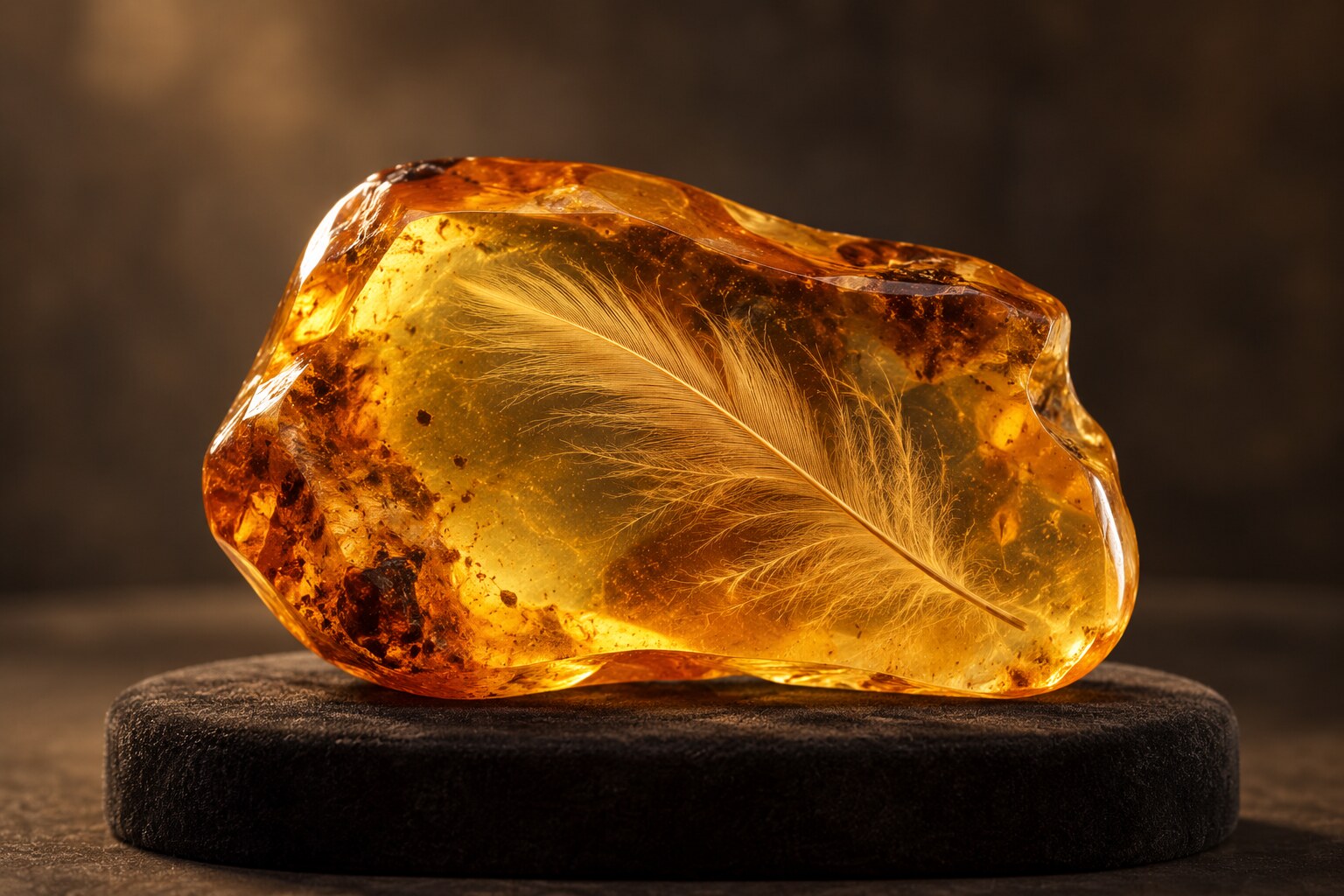
Feathers can survive in amber with astonishing three-dimensional detail. But a loose filament in a golden piece is not automatically a dinosaur feather, and a photograph cannot settle the question by itself. The strongest identifications connect visible feather anatomy with geological context and, in rare cases, bones or another closely associated organism.
That distinction is useful for collectors. “Feather-like inclusion,” “probable feather,” and “feather attached to a dinosaur tail” describe very different levels of evidence. The label should be only as confident as the specimen allows.
Amber can preserve tiny structures in three dimensions
Compression fossils often flatten soft tissues. Resin can surround a small object and preserve branching structures from several angles. That is one reason feathers in amber are scientifically valuable: researchers may be able to examine a central shaft, barbs, barbules, and their arrangement rather than seeing only a two-dimensional impression.
In 2011, Ryan McKellar and colleagues reported a diverse assemblage of feathers from Late Cretaceous Canadian amber. The specimens included simple filament-like forms and more complex feather structures. The paper compared them with proposed stages in feather development and discussed possible dinosaur and bird origins.
The important collector's caveat is that many such feathers are isolated. Without a body attached, assigning every strand to a bird or a non-avian dinosaur is difficult. Fine preservation can reveal structure without revealing the exact animal that carried it.
A tail made the association much stronger
A 2016 Current Biology paper described a section of feathered tail preserved in amber from Kachin State, Myanmar, dated in the study to about 99 million years ago. Because vertebrae and surrounding plumage survived together, the authors interpreted the specimen as the tail of a non-avialan theropod, likely within Coelurosauria.
That is a much stronger association than a detached feather. Even so, the careful wording matters. A published correspondence later raised questions about the tail's more exact phylogenetic placement and about how its feather development should be interpreted. The original authors responded and maintained a placement near the basal part of Coelurosauria. Science often improves through that kind of visible disagreement.
For a reader, “the study's authors interpreted” is more accurate than turning every detail into settled fact. Our article on why amber identifications can change explores the same habit: keep the object and the interpretation related, but not identical.
Nearby inclusions can add context without naming the owner
Another remarkable example appeared in Nature Communications in 2017. Researchers described a hard tick entangled in a pennaceous feather in approximately 99-million-year-old Burmese amber. Other tick specimens in the study carried specialized hairs from dermestid beetle larvae, evidence the authors connected with a nest environment.
The association supported the conclusion that ticks fed on feathered dinosaurs. It did not identify one precise host species. The feather could be connected to an avialan or non-avialan dinosaur within the limits discussed by the researchers. Context can make an ecological story much stronger while still leaving the owner's exact name unknown.
Read a listing from claim to evidence
If a listing advertises a feather in amber, begin with photographs of the actual piece. Look for a whole-specimen view, close-ups from more than one angle, dimensions, and a description of the visible structure. A fine branching form may be interesting, but cracks, plant fibers, fungal material, and other debris can look persuasive in a single image.
Ask what supports the word “feather.” Is the identification based on visible branching anatomy, an expert assessment, a published comparison, or simply resemblance? Then ask what supports “dinosaur.” Unless the feather is attached to diagnostic remains or has unusually strong contextual evidence, the narrower claim may be uncertain.
Locality and age are separate questions. A seller's stated source does not independently prove where an individual piece formed, and even an authentic ancient feather does not automatically reveal its owner. Save the original listing, photographs, and any report with the specimen. Our guide to photographing amber inclusions can help you make a clearer record without turning the image into an authentication claim.
Protect the evidence you already have
Do not cut, scrape, heat, dissolve, or repolish a suspected feather inclusion at home. GIA describes amber as soft, with poor toughness, and vulnerable to heat and chemicals. Surface preparation and advanced imaging used in research belong with qualified specialists.
Begin with non-destructive observation and follow the handling steps in our amber care guide. If a specimen appears scientifically unusual, share clear photographs and its documentation with a relevant museum or researcher before considering any alteration. An exciting resemblance is a reason to ask a better question—not permission to damage the evidence.
Feathers in amber are compelling because they preserve details that rarely survive. A careful label does not reduce that wonder. It shows exactly where observation ends, where interpretation begins, and why the specimen deserves another look.