 The Amber Archive
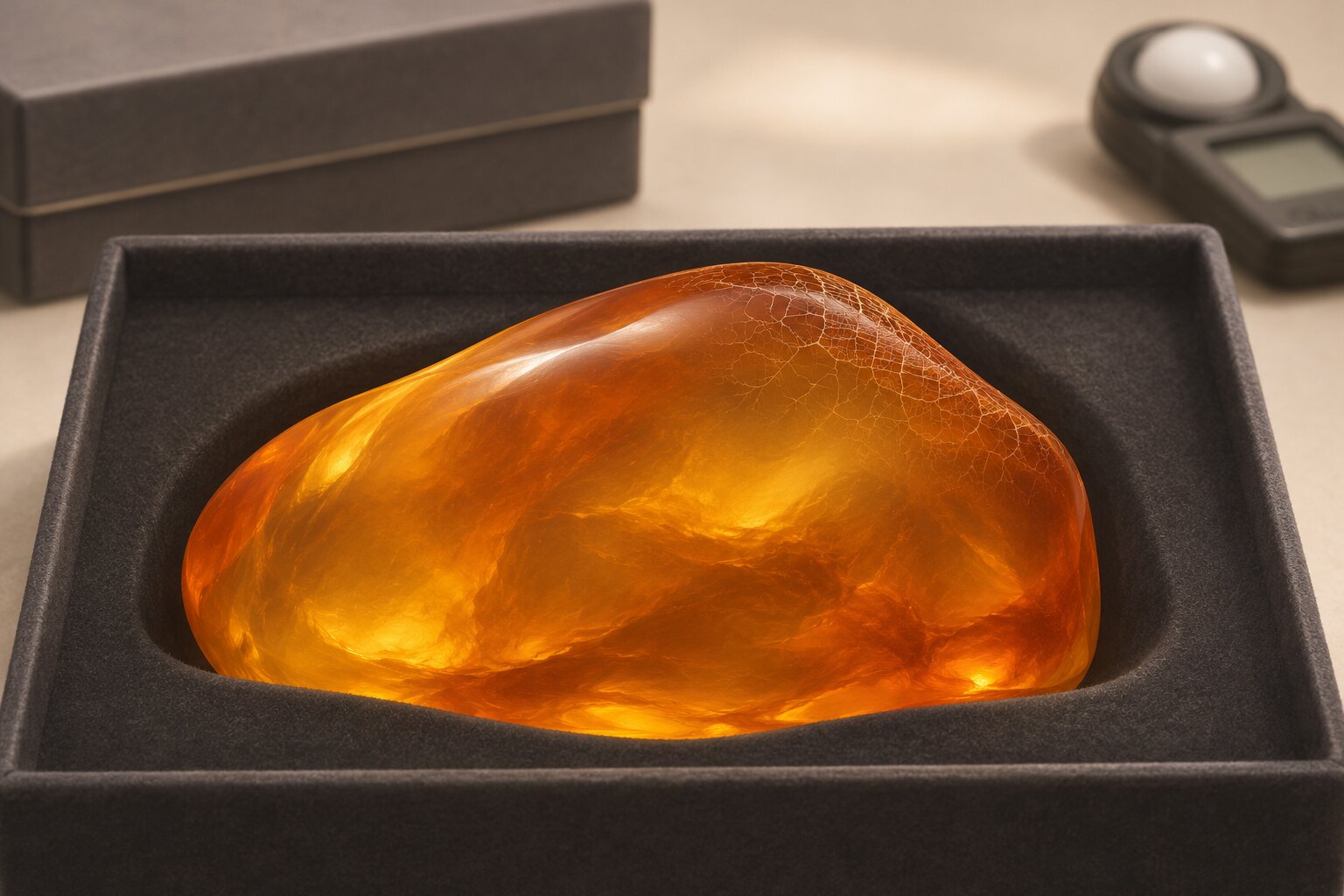
Amber often cracks because its surface is deteriorating under a combination of oxygen, light, heat, changing humidity, and physical stress. A fine network of small surface cracks is called crazing. It may begin as a cosmetic change, but deeper cracking can eventually cloud the view, loosen flakes, or threaten an inclusion near the surface.
The useful response is prevention, not a home repair. Keep conditions steady, limit light and heat, avoid chemicals and oils, and handle a damaged piece as little as possible. No single storage number suits every fossil resin, but sudden environmental swings are a warning sign.
Crazing is different from one accidental fracture
A dropped specimen may develop one obvious fracture or break into separate pieces. Crazing usually looks more like a fine mesh spreading over the surface. Museum guidance also uses crizzling for a denser network of fine cracks. As deterioration advances, the surface may become dull, flaky, powdery, or darker.
That pattern matters because it suggests a material change, not simply a scratch. A surface scratch follows contact with something harder. Crazing develops within the resin's outer layer and may branch in many directions. Under magnification, reflections can exaggerate both, so compare several lighting angles before describing what you see. Our guide to photographing amber inclusions can help document the same area without relying on one dramatic close-up.
Light and environmental changes can work together
A 2012 American Museum of Natural History study exposed five fossil resins—from Myanmar, New Jersey, the Baltic region, the Dominican Republic, and Zanzibar—to accelerated aging. The most pronounced deterioration appeared when strong light and fluctuating humidity were combined. Importantly, the resins did not all respond in the same way. Their chemistry, age, and botanical origins differ.
That is why “amber always does this” is usually too broad. The experiment found yellowing after elevated temperature in several samples, but not the Burmese amber tested. Accelerated aging also reveals vulnerability; it does not provide an exact countdown for a specimen in a home collection.
A later conservation review similarly identifies light, temperature, humidity, oxygen, and certain chemicals as linked hazards. It describes crazing, flaking, breakage, and color change as signs that storage conditions may be unsuitable.
Oxidation begins where the environment reaches the resin
A controlled study of Baltic amber used infrared microspectroscopy after thermal aging and found strong oxidation at the exterior of the samples. That supports a surface-first process. Fine cracks can then increase the area exposed to air and allow deterioration to move farther into the piece.
Oxidation is not the same as proof that a specimen is ancient, authentic, or from a particular deposit. Modern resins and plastics can also age, discolor, and crack. Condition should be recorded separately from identity, just as our first-specimen guide separates visible evidence from a seller's interpretation.
Stable, dark storage is the practical goal
For a home collection, choose a stable interior location away from windows, direct sun, display lights, heaters, hot shelves, and strong air-conditioning drafts. Support each piece in its own form-fitted tray or box with soft, inert material so it cannot roll or strike another specimen. Closed storage also reduces light exposure and dust.
Museum recommendations sometimes give targets near 18°C and roughly 50% relative humidity, but published ranges vary and different ambers respond differently. Do not create rapid humidity changes while chasing a perfect number. A steady, moderate indoor environment is more useful than repeatedly moving a specimen between very dry and humid locations.
When displaying amber, use short periods and low, indirect light. Save photographs and condition notes so new cracks, color changes, or loss of clarity are easier to recognize. The amber care guide covers gentle everyday handling and storage.
Do not oil, polish, or glue a crazed specimen yourself
Oil may temporarily make cracks look less visible, but conservation research warns against vegetable oil, mineral oil, alcohol, disinfectants, hydrogen peroxide, and other solvents. These substances can alter the surface or cause irreversible damage. Re-polishing also removes original material and can reach an inclusion close to the surface.
GIA recommends warm, mildly soapy water for routine cleaning, but an actively flaking or deeply cracked specimen is no longer a routine cleaning job. Stop unnecessary handling, photograph its present condition, keep loose fragments together without adhesive, and consult a qualified conservator or museum specialist. The National Park Service gives the simplest useful rule when treatment is uncertain: do nothing and ask a conservator.
Crazing does not erase a specimen's interest, but it changes the priority from clearer viewing to preservation. A stable environment and careful documentation cannot reverse existing cracks. They can reduce avoidable stress and protect the evidence the amber still holds.